
How Bright Is That? Stellar Magnitude, Explained Simply
Astronomy's brightness scale runs backwards and it's 2,000 years old. Five minutes here and you'll read any target list like a pro.
Every target list in astronomy, including ours, tags objects with a magnitude. It's the single most useful number for predicting whether your smart telescope will nail a target in ten minutes or struggle for an hour. It's also backwards, logarithmic, and more than two thousand years old, three properties that make it genuinely confusing the first time you meet it. Give this page five minutes and you'll read any target list like a pro, and, just as important, you'll know the one famous trap the number hides.
Backwards by history
Around 130 BCE, the Greek astronomer Hipparchus catalogued the stars and ranked them by brightness: the most brilliant were "first magnitude" stars, the next tier "second magnitude," and so on down to "sixth magnitude," the faintest his eyes could detect.[1] Think of it like prize rankings: first class, second class, third class. Nobody was doing photometry; it was a naked-eye sorting exercise by one careful observer on a Greek island.
The ranking stuck for two millennia, which is why the scale runs the "wrong" way today: smaller numbers mean brighter objects. And once astronomers started measuring things brighter than Hipparchus's first-class stars, the scale had nowhere to go but below zero. That is why the very brightest objects carry negative magnitudes. The Sun is magnitude -27, the full Moon about -13, Venus around -4, and the brightest night-time star, Sirius, sits at -1.5.[2]
So when you scan a target list, recalibrate your instincts: magnitude 2 is bright, magnitude 8 is telescope territory, magnitude 12 is faint. It feels backwards for about a week, and then it becomes second nature.
Why did astronomers keep such an awkward convention for two thousand years? Partly momentum: every star catalog ever compiled used it, and renumbering the sky was never worth the chaos. But partly because the scale, for all its quirks, matches how human eyes actually judge brightness, in ratios rather than absolute amounts, which is exactly the property the modern definition would later make precise. The ancient ranking turned out to be built on surprisingly sound instincts.
Logarithmic by definition
For 2,000 years the scale was descriptive, one observer's eyeball versus another's. In 1856 the English astronomer Norman Pogson gave it a precise mathematical definition: a difference of exactly 5 magnitudes equals exactly 100 times in brightness.[3] Do the arithmetic and each single magnitude step is about 2.5 times brighter or fainter than the last.
That "about 2.5 per step" rule is worth memorizing, because the scale hides how big the differences are:
- 1 magnitude apart: about 2.5 times different in brightness.
- 2 magnitudes: about 6 times.
- 3 magnitudes: about 16 times.
- 5 magnitudes: exactly 100 times.
- 10 magnitudes: 10,000 times.
So magnitude 5 isn't "a bit" fainter than magnitude 3; it's over six times fainter. The compression is the point: the scale squeezes an enormous range of brightness, from the Sun to the faintest smudge your telescope can dig out, into a tidy two-digit number. Convenient, but only if you remember that small differences in the number are large differences in the light.
Reading magnitudes like an imager
Enough history. Here is what the number means when you are choosing tonight's target. Rough smart-telescope rules of thumb for deep-sky objects:
| Magnitude range | Difficulty | What to expect from a smart telescope |
|---|---|---|
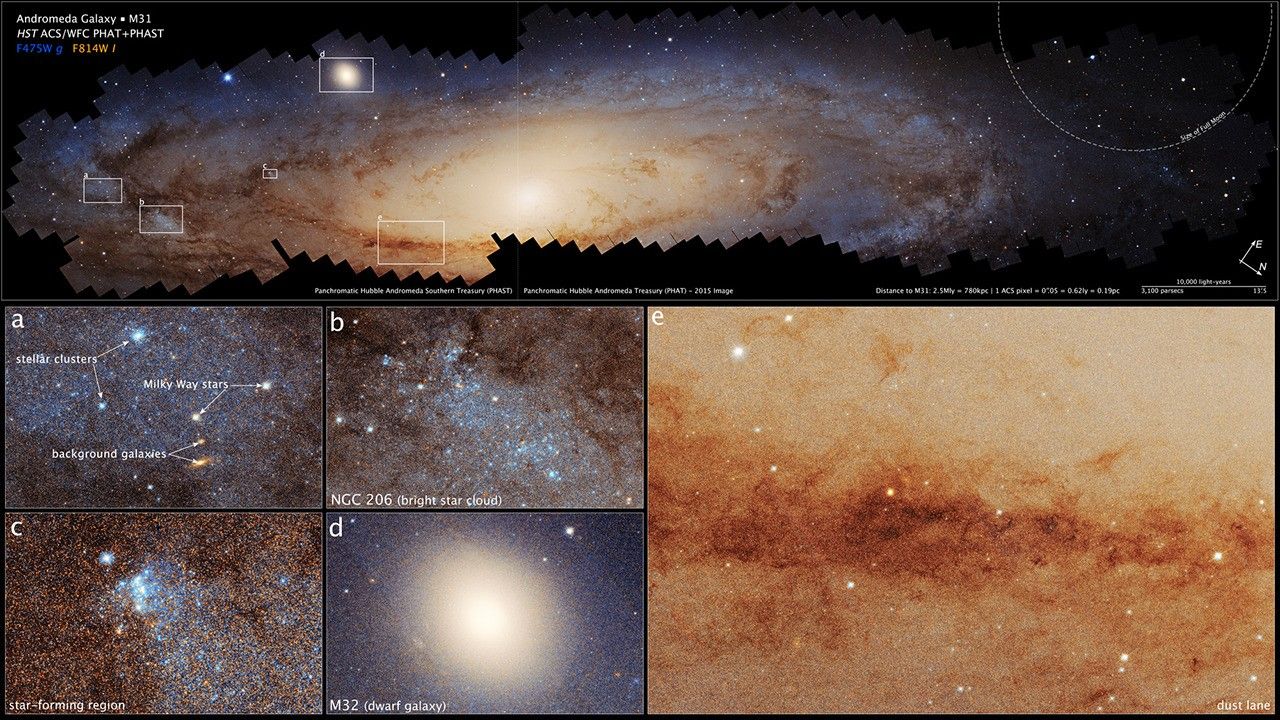
| 3-6 | Showpieces | Bright cores appear in your first minute of stacking. Andromeda (3.4), the Orion Nebula (4), the Hercules Cluster (5.8). |
| 6-9 | The sweet spot | Most Messier objects live here; 10-30 minutes of stacking produces satisfying results under decent skies. |
| 9-12 | Committed territory | Long stacks, dark skies, and patience. Plan these as the main event of a session, not a snack. |
| Fainter than 12 | Project class | Multi-night integration and a dark site. Rewarding, but earn your stripes on brighter targets first. |
Two adjustments to layer on top of the table. First, your sky moves every boundary: under a bright suburban sky, shift each row roughly one category harder. Second, altitude matters: a magnitude 8 target near the horizon behaves like a fainter one, because you are imaging it through a thick wedge of atmosphere.
The catch: surface brightness
Now the trap, and it catches nearly every beginner at least once. Magnitude measures an object's total light, added up as if the whole object were squeezed into a single point.[4] That works perfectly for stars, which really are points. It quietly misleads for anything extended.
A galaxy can carry a bright-sounding magnitude yet spread that light across an area larger than the full Moon, making every individual patch of it dim. Astronomers call the light-per-patch measure surface brightness, and for imaging extended objects it matters as much as magnitude itself.
A worked example: the magnitude 5.7 galaxy that isn't easy
The classic demonstration is the Triangulum Galaxy, M33. On paper it is magnitude 5.7, which sounds like showpiece territory, brighter than plenty of famous, easy targets. New imagers point at it expecting fireworks and get, at first, almost nothing: a vague brightening where a galaxy should be.
The reason is that Triangulum is huge and face-on, so its respectable total light is buttered thinly across a large patch of sky. Each pixel of your sensor receives only a trickle. Meanwhile a compact planetary nebula of magnitude 9, nominally more than twenty times "fainter," concentrates all its light into a tiny disk and pops out of the noise within minutes. The rule that resolves the paradox: when two targets have similar magnitudes, the smaller one will almost always look brighter, faster.
So read target lists with both eyes: one on the magnitude, one on the object's size. Big and bright is wonderful. Small and bright is easy. Big and faint is a project. Our target lists include apparent size for exactly this reason.
The floor keeps moving
Hipparchus's magnitude 6 limit is still roughly the naked-eye floor under a good dark sky.[5] Your smart telescope, stacking for half an hour, reaches magnitude 13-15 depending on sky darkness. Run the Pogson arithmetic on that gap: 7 to 9 magnitudes past your eye is hundreds of times fainter, closing in on a thousand.
That's the quiet superpower of these little scopes. They don't see better than you so much as they remember light: minute after minute, frame after frame, they accumulate photons your eye would have discarded a fraction of a second after catching them, until the invisible becomes a photograph. Every extra minute of stacking pushes your personal magnitude floor a little deeper.
A ladder you can climb
This moving floor suggests a genuinely fun way to structure your first season: treat magnitude as a ladder and climb it deliberately.
Start on the bottom rungs, the magnitude 3-6 showpieces, where success is nearly guaranteed and you learn the scope's rhythms without suspense. When those feel routine, step up to the 6-9 range, where most of the Messier catalog lives and where planning starts to matter: altitude, moonlight, and integration time all begin to show in your results. Then push into the 9-12 rungs, where every capture is a small expedition, and where your choices about sky darkness and total integration make the difference between a smudge and a keeper.
Somewhere along the way, keep a simple log: date, target, magnitude, sky, integration time, and whether the result satisfied you. After a couple of months, that log becomes something valuable: a personal map of what your equipment, your skies, and your patience can reach. No published number can tell you your own limiting magnitude; only the ladder can.
And the ladder never really ends. There is always a rung one step fainter: a dimmer galaxy, a more elusive nebula, a cluster that needs just a bit more darkness. That endless next rung, more than any single image, is what keeps people setting up their telescopes year after year.
Five landmarks worth memorizing
You do not need to memorize the whole scale; five anchor points let you place any target you'll ever meet by interpolation.
- -13, the full Moon. The reason faint-target imaging pauses for the bright half of the month. When something is within shouting distance of this, it rules the sky.
- -1.5, Sirius. The brightest star in the night sky. Anything with a negative magnitude is either a planet near its best, or the Moon.
- 3.4, the Andromeda Galaxy. The "bright showpiece" anchor: visible to the naked eye from a dark site, instant in the stack.
- 6, the naked-eye limit. The historical edge of human vision under dark skies. Everything fainter belongs to optics.
- 13-15, your smart telescope's reach. The practical floor for a good stacked session, moving deeper with darker skies and longer integration.
With those five pegs in your head, a "magnitude 7.9 cluster" instantly registers as: invisible to the eye, comfortably within reach, a solid mid-session target. That is the entire skill.
A worked example: reading tonight's list
Imagine three entries on tonight's ranked list, and let's read them the way an experienced imager would.
Entry one: an open cluster, magnitude 4.5, compact. Bright and small: light concentrated onto few pixels. Verdict: near-instant gratification, a perfect first target while the sky finishes darkening. Ten minutes will look finished.
Entry two: an emission nebula, magnitude 7, medium-sized. The sweet spot. Invisible to the eye, easy for the scope, and the dual-band filter will make the sky behave. Verdict: the evening's main course; give it 30-45 minutes of integration and expect to be pleased.
Entry three: a face-on spiral galaxy, magnitude 8, listed as large. Here the alarm bell should ring: a bright-sounding number attached to a big object means low surface brightness. Verdict: a genuine project. Under a suburban sky it may never fully cooperate; from a dark site with an hour or more of integration, it becomes a trophy. Schedule accordingly, and don't let it be your first-ever target.
Notice that the decision was never made by magnitude alone. It was magnitude plus size, read together, plus an honest look at your sky. Three numbers, ten seconds of thought, and your whole session falls into place.
What magnitude quietly ignores
One last calibration: magnitude describes the object, not your night. Three things routinely make a target act fainter than its number:
- Your sky. Light pollution raises the background the target must beat. The magnitude didn't change; the contest got harder.
- Its altitude right now. Low targets shine through more atmosphere, which dims and blurs them. The same object is effectively fainter at 20° than at 60°.
- The Moon. A bright Moon brightens the entire sky, taxing every target on the list at once.
This is exactly why our nightly rankings do not simply sort by magnitude: they weigh brightness against altitude, moonlight, and timing to answer the question you actually have, which is not "what is bright?" but "what will work well, from here, tonight?"
Common beginner questions
- Why do some lists show two magnitudes for the same star? Some stars genuinely vary in brightness over days or months, and catalogs may quote a range. For deep-sky targets, small differences between sources are normal; treat published magnitudes as good estimates, not gospel.
- Is a negative magnitude special? No, it is just "brighter than the old zero point." The scale kept extending as measurement got better; negative numbers are ordinary members of the same ladder.
- Does magnitude tell me how far away something is? Not by itself. The magnitude in target lists is apparent magnitude: how bright the object looks from Earth. A dim nearby star and a brilliant distant one can share the same apparent magnitude. (Astronomers use a separate "absolute magnitude" to compare true luminosities.[6])
- My scope "reached magnitude 14" one night and struggled at 11 the next. Is it broken? No. Your limiting magnitude moves with sky darkness, moonlight, haze, target altitude, and integration time. The scope is the constant; the sky is the variable.
Put it to work tonight
- Open Sky Tonight or your favorite park page and read down the target list looking only at magnitudes. Predict, before you shoot, which targets will appear fastest in the stack.
- Pick a three-course meal: one showpiece (magnitude 3-6) to start, one sweet-spot target (6-9) as the main event, and, if the night is going well, one stretch target (9-12) to finish.
- Run the surface-brightness experiment yourself: image one large face-on galaxy and one compact cluster or nebula of similar magnitude, ten minutes each, and compare. The lesson will stick permanently.
- Keep notes on the faintest object you've cleanly captured from each site you use. That personal limiting magnitude, home versus dark site, is the most honest measurement of what light pollution costs you.
Magnitude is a 2,000-year-old ranking system wearing modern mathematical clothes. Backwards, logarithmic, blind to size, and once you know those three quirks, it becomes exactly what it should be: the fastest way to size up a target before you spend a single minute of darkness on it. Every clear night hands you a limited budget of dark hours; reading one small number well is how you stop spending them on the wrong targets.
Notes & sources
- Hipparchus's second-century BCE catalog ranked naked-eye stars from first (brightest) to sixth (faintest) magnitude, the origin of the modern scale. Encyclopaedia Britannica, Magnitude (astronomy) ↩
- Reference magnitudes for the Sun (about -27), full Moon (about -13), Venus (about -4), and Sirius (-1.5). Sky & Telescope, The stellar magnitude system ↩
- Norman Pogson's 1856 formalization defines 5 magnitudes as exactly a 100-fold brightness ratio, making each step roughly 2.512 times. Encyclopaedia Britannica, Magnitude (astronomy) ↩
- Integrated (total) magnitude versus surface brightness for extended objects, and why large diffuse objects appear fainter than their magnitude suggests. Sky & Telescope, The stellar magnitude system ↩
- Magnitude 6 is the traditional naked-eye limit under dark skies, matching the faint end of Hipparchus's original ranking. Sky & Telescope, The stellar magnitude system ↩
- Apparent magnitude measures brightness as seen from Earth; absolute magnitude standardizes stars to a common distance to compare true luminosity. NASA, Stars overview ↩